
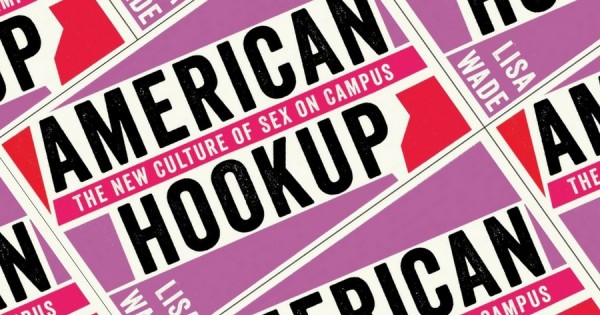
American Hookup: The New Culture of Sex on Campus
In her book, American Hookup: The New Culture of Sex on Campus, sociologist Lisa Wade examines the pervasive sexual hookup culture that dominates America’s higher education system. After gathering extensive research on the topic, Wade determines that America’s young people are crying out for help because this boundless culture of hookup sex on campus is making them anxious and depressed, and in many cases, dissatisfied and traumatized. But the cause of this unhappiness isn’t necessarily the act of hooking up at all. Instead, it’s the establishment of hookup culture as a norm and requirement of being a college student. Wade analyzes the winners and losers of hookup culture, suggesting that there may be fewer winners than society might have us believe.
Wade begins by giving us a how-to guide to hookup culture, specifically the steps that college students take to participate in hookup culture correctly. These steps are 1) pregaming with alcohol, 2) grinding at the party or bar, 3) initiating a hook-up often lacking verbal consent, 4) hooking up and 5) establishing emotional. A failure to do one of these steps might result in a failure to hook-up, the labeling of one as an outsider to the culture or pose the risk that the other party involved gets the wrong impression.
Wade attributes the feminist movement and gay liberation movement of the 60s and 70s to the reemergence of these more permissive attitudes about sex. Feminists hoped to break down the gender stereotypes that had permeated society since the 1800s by allowing women to be more sexually liberal and equal in all aspects of life. Instead, stereotypes about femininity and masculinity became even stronger. And while the sexual double standard is no longer explicitly enforced and women are indeed free to have more masculine pursuits, males have become arguably more evasive of anything considered “feminine”.
Wade explores how college parties lay the perfect groundwork for hookup culture because they manifest drunkenness and horniness. Hookups are imbedded into the party script and institutionalized in higher education. Frequently the “winners” are white, heterosexual fraternity men, but not everyone opts in and not everyone is allowed to either. For some, engaging in hookup culture reaffirms stereotypes about their race, gender or sexuality. Others strive to participate but are shut out because of these same things. Those who choose to abstain are considered losers and feel isolated because hookup culture is so rooted in social life. Those who do opt-in, both male and female, report being unsatisfied and traumatized.
Another important aspect of hookup is the absence of emotions, but as Wade points out “saying we can have sex without emotions is like saying we can have sex without bodies” (Wade, p. 135), which is certainly not the case. In hookup culture, players do what they can to protect themselves at all costs and this means being, careless, carefree and void of emotional attachment. Even when college women do take steps to “be chill”, many men automatically stigmatize women as emotional creatures who naturally are always looking for relationships.
This is not the only form of gender inequality. Men who engage in hookup culture are twice as likely to orgasm than women, a clear example of the pervasive “orgasm gap” that permeates college campuses. Even though it’s common for women to orgasm when they’re in relationships, hookup culture doesn’t promote reciprocity and disrespect towards women is used as a bargaining chip, especially if the woman being hooked up with is deemed “ugly” by the man or his friends. This solidifies male domination and female subordination. It also solidifies the need to meet high standards of beauty to participate and succeed in this culture.
Wade attributes the theory of situational/opportunity rape as to why sexual assault is also extremely prevalent in hookup culture. College campuses, or rather college parties, provide a rape-prone place for rape-supportive people. Coercive behaviors blend into hookup culture and are naturalized, justified and glorified there.
Lastly, Wade checks in with her students several years later, both at the end of their college careers and after they have left hookup culture behind. Unsurprisingly, many who were initially eager to participate have defected. Furthermore, dating has replaced hookup culture in their adulthood but after four years of hookup culture, these students don’t know how to be honest with their intentions or emotions and report failing at relationships.
Lisa Wade is an associate professor of sociology at Occidental College and has degrees in philosophy, human sexuality and sociology. She has a PhD in Sociology from the University of Wisconsin-Madison and a Master of Arts in Human Sexuality from the University of California-Santa Barbara. The research compiled in this book was collected from first-year students in introductory sociology classes or sexuality-themed writing classes at two liberal arts school over the course of six years (2010-2015). She gathered further data from students at colleges across the country that she visited and from student accounts in newspapers about hookup culture. Wade cites numerous research studies and draws data heavily from the Online College Social Life Survey as well.
Wade’s research is widely based in the firsthand accounts from her students which is cause for some skepticism. These students were told to disclose only what they felt comfortable sharing, and while it’s probable that many of them indeed gave truthful accounts, there is always the problem of concealment and enlargement when self-reports are involved (Hyde & DeLamater, 2017, p. 47). That being said, many of Wade’s points are rooted in fact.
The emergence of a new culture of sex, or at least the emergence of different attitudes and practices regarding casual sex and hooking than those of previous generations, has been supported by other research. Monto and Carey found in their analysis of sexual attitudes and practices between 1988 and 2012 that young adults of the current era were far more likely to engage in sex with a casual date or pickup and less likely to report sex with a regular partner (Monto & Carey, 2014). Young adults are interacting with sex much different than the generations before them, but this hookup culture isn’t easily accessible to all of them either.
In a recent study of racial inequalities in college, it was found that White students reported 4.7 hookup partners compared to averages of Black, Latino and Asian students who reported 3.3, 3.2 and 2.2 hookup partners, respectively. These variances increase when you take gender into account, as White women reported double the number of hookups than the average for all other groups of women and white Asian men, for example, reported half as many hookups as White men (Spell, 2016). This supports Wade’s argument that some races are valued more over others in hookup culture and that hookup culture is dominated by White people.
Inequalities exist among men and women as well within the context of the physical hookup as well. The “orgasm gap” Wade speaks of, where women are less likely to orgasm in casual sex encounters than men, is very real. The phenomenon that women of the same age are more likely to orgasm when they have sex in the context of a committed relationship is rooted in other research as well (Hyde & DeLamater, 2017, p. 239-240). These sentiments are echoed in the words of her students and results of the Social Life Survey.
The evidence for alcohol’s prevalent role in hookup culture cannot be denied either. Fielder and Carey found that a median of three alcoholic drinks preceded 64% of hookups in college (Fielder & Carey, 2011). A similar percentage was found in a study by LaBrie, and she also found that among these hookups, only 42.9% of students reported that if alcohol hadn’t been involved, they would’ve still hooked up with the sexual partner (LaBrie et. al, 2014). In addition, studies have found that 25% of students that drink to the point of blacking out engage in sexual activity during their blackout (White et al., 2003), which suggests that risky sexual behavior is present. These studies, as well as others, prove how embedded alcohol is in hookup culture.
Another recent study presents a strong case for sexual assault’s prevalence among hookup culture. In a survey of students at a liberal arts university, 78% percent of unwanted vaginal, anal and oral incidents took place while partners were “hooking up”. Furthermore, a fourth of the students surveyed who engaged in hooking up also reported being explicitly, while none of the students who had never hooked up reported this (Flack et. al, 2017). Sexual assault and hookup culture frequently coincide with one another and the college sexual field promotes male dominance, sexism, false beliefs about rape, hypermasculinity and homophobia.
Though some of Wade’s research can be disputed and the nature of her qualitative methods warrant some query when trying to apply her claims to the entirety of the American college system, Wade’s research is validated by many and presents an overall accurate, in-depth portrayal of what casual sex is like in college. And her research is important. It not only aims to inform all generations about the sex culture that penetrates college campuses, it also provides a compelling picture as to why this culture must change. Few win in the end. Perhaps, as Wade stated in her conclusion, we must continue to say yes to casual sex, but no to “the absence of care, unfair distribution of pleasure, unrelenting pressure to be hot and risk of sexual violence” (Wade, p. 246) that currently accompanies casual sex in college. Changing the culture will change the game and maybe, in turn, make sex not so much of a brutal game at all.
References
Fielder RL, Carey MP. Prevalence and characteristics of sexual hookups among first-semester female college students. Journal of Sex and Marital Therapy. 2010b;36(4):346–359. doi: 10.1080/0092623X.2010.488118.
Flack, W. F., Daubman, K. A., Caron, M. L., Asadorian, J. A., D’Aureli, N. R., Gigliotti, S. N., . . . Stine, E. R. (2007). Risk Factors and Consequences of Unwanted Sex Among University Students. Journal of Interpersonal Violence, 22(2), 139-157. doi:10.1177/0886260506295354
Hyde, J. S., & DeLamater, J. D. (2017). Understanding human sexuality(13thed.). New York, NY: McGraw Hill.
LaBrie, J.W., J. F. Hummer, T. M., Ghaidarov, A. Lac, and S. R. Kenney. 2014. “Hooking up in the College Context: The Event-Level Effects of Alcohol Use and Partner Familiarity on Hookup Behaviors and Contentment.” Journal of Sex Research 51 (1): 62–73.
Monto, M. A., & Carey, A. G. (2014). A New Standard of Sexual Behavior? Are Claims Associated With the ‘‘Hookup Culture’’ Supported by General Social Survey Data? Journal of Sex Research, 51(6), 605-615. doi:10.1080/00224499.2014.906031
Spell, S. A. (2016). Comparing Intimacies: Race Relations and Racial Inequality in Hookup Culture. University of Pennsylvania Scholarly Commons. doi:1-1-16
White, A. M. (2003). What happened? Alcohol, memory blackouts, and the brain. Alcohol Research and Health, 27(2), 186–196
 SOPHIA PORTELLI