Modern Family and Modern Families: How TV Portrays Various Family Arrangements
Television has always brought my family
together. When I was younger, I remember us gathering around our television and
eagerly tuning into our favorite shows every week. In the comfort of our home,
we watched our favorite characters and families overcome both comical and
serious hardships, just as our family went through our own highs and lows of daily
life. My nuclear family related to the nuclear families we saw on television,
but we also found ways to connect to other familial arrangements that were portrayed
on screen, albeit these types of family portrayals were not exceedingly common.
Diversity and representation in the media has
changed drastically since television’s conception. The word ‘family’ means so
much more now than it did when my parents were growing up. This change in
connotation is related to the growing representation of non-nuclear families in
film and TV. For example, the closest my parents had to a television depiction
of a ‘blended family’ was probably The
Brady Bunch; but my generation and those younger than me have programs like
Modern Family and The Fosters to portray more blended,
atypical familial arrangements. And while the nuclear family is still arguably
the most typical family arrangement in the United States, there are countless
other family types in America and representing them on screen helps to naturalize
them and allows for viewers to connect to stories that resemble their own.
Walter Podrazik, a consulting curator of the Museum of Broadcast Communications,
said of family representation on TV, “[Family] is a shortcut to instant
identification. It’s ‘Oh yeah, I’ve got one of those,’ or ‘I came from a family
like that.’ Then it’s just a matter of how much fun you want to have with it or
how dramatic you want to make it. It’s interesting that so many of the plots,
whether it’s now or going back 50 years are about the family coming together”
(France, 2010). And it’s true. When we see any type of family coming together
on the screen, it shapes the way we feel about our own family and the families
we see around us.
Social Cognitive Theory suggests that “most human behavior
is learned through the observation of behavior modeled by others, including
behaviors modeled by characters on television” (Davis, p. 207) This means that television is teaching us how
to act and teaching us what to believe. The way in which different types of
families are portrayed on TV completely shapes the way society feels about
them. As learned in class, gender plays an enormous role in constructing
familial/partner arrangements. The role of women in TV families has changed
dramatically, just as the role of women in real life has shifted too. By
exploring the way in which television depicts different types of families (like
single-parent households, same-sex couples, nuclear families etc.), we can
begin to understand why certain arrangements are more prevalent or accepted and
we can start to comprehend societal connotations surrounding each family type.
Furthermore, we can examine how their portrayals have helped shape societal
discourses surrounding them. “The
nature of gender representation in television content has changed over time,
suggesting that television is reflecting or introducing changes in attitudes
within society” (Davis, p. 210). Non-nuclear
families were once shunned for not agreeing with society’s definition of a
typical family, but with increased representation, society’s opinion of what a
family should look like is fluid and more open.
I chose to compare several of my favorite TV
families, each different and representative of a more non-typical familial
arrangement with the hope of understanding how they’re being represented on
screen and how they relate to changing societal norms. I watched episodes from
each TV show and made commentaries on how they were representing relationships,
gender and families.
Background Research
Before examining three fairly current
television shows, I felt it was important to understand how family portrayals
on TV have changed. According to Andrea Press, “In its golden era, television
worked to create a ‘unifying address with which to capture an American
majority’ and created ‘an immediate mainstream through which notions of proper
behavior and a desirable lifestyle were represented’” (Press, p. 140). This
means that early television depictions of the family showcased the nuclear
family and not much else. Sitcoms like Leave
it to Beaver and Father Knows Best
centered around two heterosexual parents and their biological children.
This golden era of television coincided with
the “Golden Age” Era of the United States (spanning from the 1940s to the
1970s) when the breadwinner/housewife
model of marriage was most common. In these marriage types, the male in a
heterosexual couple was the sole wage-earner of the household and supported
their wives financially while the woman did all of the housework and child care
(Lecture 24). Women were pressured with the cult
of domesticity, or the notion that women could and should wholeheartedly
embrace the work of making a loving home (Lecture 24). These sentiments were
reflected on television as well. Early TV families featured a hardworking
father and a “woman
occupying the confined role and the inequality that comes with the status of
dependent wife and mother” (Hood-Williams, p. 270). Furthermore, many early
radio and television soap operas specifically played off the fact that
housework and childcare was supposedly feminized
labor, labor that is perceived as the proper and natural responsibility of
women (Wade and Ferree, p. 251). The term ‘soap opera’ is derived from the fact
that these programs were paid for by soap companies and were frequently full of
cleaning product advertisements that women needed for housework. More so, soaps
aired during the day when women were theoretically the only ones tuning in. All
of these factors relate back to the traditional American version of the gender
ideology, “based on a notion of separate public and private spheres, where
women are generally believed to be better suited for attending to the home and
raising children and men to breadwinning” (Davis, p. 205).
Most of these early programs also only featured
white, “fully-American” families. However, trailblazing shows fought to show
more diverse characters to American television viewers. The Goldbergs (1949) was a situation comedy about a Jewish family that
touched on actual problems that Jewish families faced in society. I Love Lucy (1951) was one of the first
depictions of an interracial couple on TV. Later, The Andy Griffith Show (1960) showed a family headed by a single
widowed parent. Roots (1977) and The Cosby Show (1984) represented African-American families in a
positive light, in a media climate that historically represented
African-Americans as overly violent or lazy. Dynasty (1984) featured one of the first openly gay couples on
television.
As these shows fought for their spots on the
screen, TV and society began to change and acknowledge the existence of other
types of families and characters. Now, the entertainment industry “recognizes
the importance of various racial, sexual and ethnic minorities. In its new
role, television in part reflects our increasing cultural recognition of the
true diversity of gender roles and family forms that constitute our culture”
(Press, p. 140). And while there are still portrayals of the typical,
traditionalist marriages/nuclear families on television, many shows contain a
considerable amount of diversity and variation. This brings me to the
television shows I chose to analyze.
The
Fosters follows the lives of an
interracial lesbian couple, Stef and Lena, who are raising four adopted
children and one biological child. One
Day at a Time follows the life of single-mother Penelope Alvarez as she
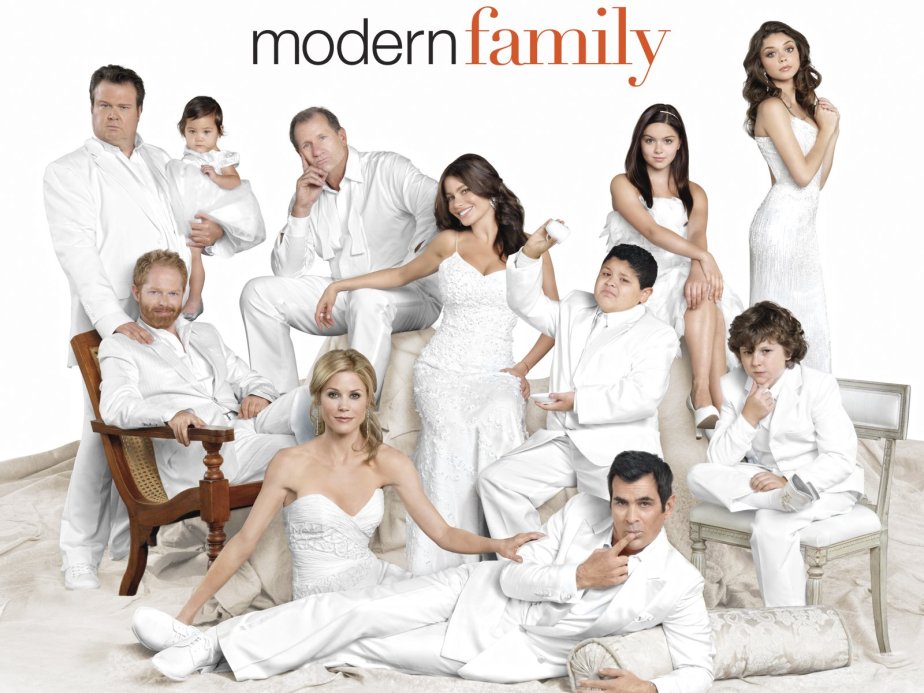
raises her two children with the help of her own mother who lives in her home. Modern Family showcases three families
that are all interconnected and related. The first family is that of Jay
Pritchett and his much younger wife Gloria as they raise her son from another
marriage and later, their own biological child. The show follows Jay’s two
children, Claire and Mitchell, and their families as well. Claire is part of a
nuclear family with her husband Phil and their three kids. Mitchell is gay, and
he and his partner Cameron have an adopted child together. The Fosters, One Day at a Time and Modern Family all render atypical familial arrangements.
Discussion
The
Fosters depicts a same-sex, interracial marriage and a family forged mostly
from the U.S. foster care and adoption systems. When asked for their
inspiration for the show, creator Bradley Bredeweg explained that there was a
lack of representation of women raising families on TV. “We realized that there
was a kind of a vacuum when it came to stories about women raising families.
Many of our own friends are moms raising biological kids. Some of them have
fostered and adopted. Suddenly, we realized that we had a story here that
hadn’t been told on television before” (Valenza, 2014). Bredeweg and his
cowriter chose to not only represent an atypical familial arrangement but also
represent a non-stereotypical same-sex relationship.
Stef and Lena aren’t a typical same-sex couple
and the way in which they raise their children and choose to divide their labor
are reflective of this. Both Stef and Lena have full-time jobs and they chose
to employ an egalitarian division of
labor, or a relationship in which both partners do their fair share of the
breadwinning, housekeeping and childbearing (Wade and Ferree, p. 254). This
isn’t necessarily reflective of how many non-TV same-sex couples choose to
split the labor. In fact, approximately 75% of same-sex couples choose to
employ a neo-traditional division of labor and tend to gender household labor,
also known as ‘heterogendering’ (Lecture 25). Interestingly enough, problems actually
arise for Stef and Lena when Lena becomes pregnant and the couple must shift
towards a more neo-traditionalist division of labor. Lena resents Stef for how
much of the mental load and second shift has suddenly shifted to her, and the
couple most overcome this obstacle together. Stef and Lena’s family is also
comprised of mostly children who have been adopted. While one son is Stef’s
child from a marriage to a man, the rest of the kids have been adopted. Several
of the kids are biological half or full siblings of one another and they are
not all the same race. The dysfunctional, blended family has their fair share
of difficulties but Lena’s famous line “DNA doesn’t make a family; love does”
is beautifully reflective of how atypical familial arrangements are just as
natural and acceptable as that of nuclear families. Their family’s portrayal on
screen has allowed for increased acceptance of this notion.
In comparison, the same-sex relationship that
Cameron and Mitchell have in Modern
Family is much different. Mitchell is the sole breadwinner of their family
and Cameron is a content homemaker. They follow a neo-traditionalist labor
division, where the woman is able to work if she desires but only if it doesn’t
interfere with the “real” duty to take care of her husband and children (Wade
and Ferree, p. 254). Even though Cameron and Mitchell are both men, Cameron is
portrayed as the much more feminine partner in their relationship. He works a
few short-lived jobs throughout the show, but he’s primarily the homemaker and
Mitchell the breadwinner. Opposite Lena and Stef’s issues, Cameron and Mitchell
are shown to have problems when Mitchell worries that their adoptive daughter
loves Cameron more because he is able to spend more time with her. They ‘switch
roles’ for several episodes before realizing that their arrangement works well
the way it is and their daughter, Lily, loves both of her fathers in equally
wonderful ways.
Perhaps at this point we should move on to the representation of single-parent families and divorced/separated characters on television. Before Penelope Alvarez was separated from her estranged husband Victor on One Day at a Time, the couple promised they would share most of the second shift, work that greets parents when they come home from work (Wade and Ferree, p. 248). But after they both re-enlist in the army, they need the help of Penelope’s parents to raise their new child. Fast-forward to the present and Penelope is separated from Victor, divorce pending, and is working full-time to support her family. Her mother, Lydia, lives with them and helps with Penelope’s two children as she works long hours as a nurse. A lot of the first season revolves around Penelope finding ways to make things work. She frequently laments to her mother that she “wasn’t supposed to have to do this [raising her family] alone” and that it’s difficult without Victor. Lydia does almost all of the childcare and housework. One of the very first episodes features Lydia ‘running away’ because she feels like the work she does to support the family is undervalued. This is a clear example of how unpaid labor is less valued than paid labor even though both are very important to making a family run smoothly. Unlike other shows, One Day at a Time represents this divide in way that is rather unique, with a grandmother, her daughter and grandchildren instead of a married couple. When Victor returns at the end of the season and his daughter Elena tells him that she is lesbian, he rejects her and walks out of her Quinceañera. Elena’s extended family rallies around her in support and love. One Day at a Time reinforces that families can definitely succeed without a male presence or father, a notion that was nearly unheard of on early television. It’s also important to note that One Day at a Time was based off a television show from the 70s of the same name that featured an all-white family in the same single-parent situation and very little intersectionality. The reboot offers valuable representation for Cuban-American families.
Paula Dail and Wendy Way conducted research in
the late 80s and examined the representation of single-parent households and
were surprised to find “a
large number of single parent, male headed households being presented, since
this is clearly atypical of society in general” (Dail and Way, p. 497). This is
especially surprising when you consider that many television representations of
male single-parents/divorcees involve them getting remarried. This is true for Modern Family, since Jay Pritchett got a
divorce from his wife of 35 years and married a young Colombian woman named
Gloria. Their age difference and the fact that they are an interracial couple are
two things not frequently found on television, but their relationship offers
important representation for couples that fall into either or both of those
categories.
Jay initially appears to be
emotionally callous and very standoffish with his step-son Manny, perhaps
because Jay is from an older generation that placed the most value on
biological children. However, it’s revealed that Jay regrets working too much
and not being present with Claire and Mitchell, and he hopes to be a great
step-father to Manny. Jay and Phil, the father of Claire’s nuclear family, both
engage in forms of involved
fatherhood, or
the ideology that the ideal father today is nurturing, develops close emotional
relationships with children, and shares the joys and work of caregiving with
mothers (Lecture 24). This fact makes even Modern
Family’s portrayal of the nuclear family a unique one that reflects the
growing prevalence of involved fathers in modern society. Phil also defies many
stereotypical gender roles because he’s overly emotional, frequently receiving
Jay’s disapproval and gender-policing, but he doesn’t let this affect him.
Conclusion
All of these television shows depict families
going through real hardships and overcoming true obstacles. Where much of the
TV shows of the past represented nuclear families as “happy people with happy problems”
(Press, p. 141), family members of the modern age paint a much truer picture of
reality. No family is perfect, and no family member is without their own
problems or dilemmas. Stef and Lena must deal with discrimination because they’re
lesbian and interracial; Penelope faces sexism in her workplace for being a
single mother; Jay and Gloria deal with age discrimination. Representation of
these significant themes and of atypical family types allows for increased
acceptance and belief that there isn’t just one type of ‘normal family’. TV
sometimes follows society’s changing values, but TV can also cause society’s
values to change by representing characters and themes that haven’t been shown
before.
Shannon Davis says of increased representation
on television, “By allowing the repetitive messages of television into the
home, it is reasonable to believe that it can become a part of the individual’s
assumptions, values, and beliefs” (Davis, p. 207). By letting these characters
into our television sets and our hearts, the discourse surrounding family and
gender is changing for the better.
References
Dail,
Paula and Way, Wendy (1985). “What Do Parents Observe about Parenting from
Prime Time” Television from the Family Relations, Vol. 34, No. 4 (Oct., 1985),
pp. 491-499
Davis,
Shannon (2013). “GENDER DIFFERENCES IN THE INFLUENCE OF TELEVISION ON GENDER
IDEOLOGY? TV HOURS AND ATTITUDES TOWARD EMPLOYED MOTHERS: from the
International Review of Modern Sociology, Vol. 39, No. 2 (Autumn 2013), pp.
205- 223
France, L. R. (2010,
September 01). The evolution of the TV family. Retrieved from http://www.cnn.com/2010/SHOWBIZ/TV/09/01/families.on.tv/index.html
Hood-Williams,
John (1986). “Soaps and the Sociology of the Family” from the Teaching
Sociology, Vol. 14, No. 4 (Oct., 1986), pp. 270-272
Press,
Andrea (2009). “Gender and Family in Televisions Golden Age and Beyond” from The Annals of the American Academy of Political and Social
Science, Vol. 625, The End of Television? Its Impact on the World (So Far)
(Sep., 2009), pp. 139-150
Valenza, R. (2016, February
02). Ever Wonder How A Show About Lesbian Moms Made It On ABC Family? Here’s
How… Retrieved from https://www.huffingtonpost.com/2014/01/10/bradley-bredeweg-the-fosters_n_4569014.html
Wade, L., & Ferree, M. M.
(2015). Gender: Ideas, interactions, institutions. New York: W. W.
Norton & Company.






 SOPHIA PORTELLI